Category Archives: Hyde Park Pest Control

Wood Eating Insects in Hyde Park: Beetle or Termite Signs

Wood-eating insects in a Hyde Park home are usually termites or powderpost beetle larvae, and their signs differ enough to matter. Fine powder under tiny round holes points toward beetles, while mud tubes point toward subterranean termites. Carpenter ants do not eat wood, but they hollow it out for nests, so they belong on the list too. Check the debris and the wood around it before choosing a treatment.

If you have tried everything to stop powder collecting beneath a joist, painting over the holes will not reach larvae inside. Save a sample of the debris and photograph where it falls. That gives an inspector more to work with than holes alone.

What else eats wood besides termites?

Powderpost beetle larvae feed inside seasoned hardwood. Other beetles, including the oldhouse borer, can also damage framing long after construction. Identifying the insect matters because some borers can reinfest wood, while others emerge once and do not return to seasoned lumber.

Carpenter ants do not eat wood. They excavate smooth galleries for nests, usually in moist or decayed areas. Carpenter bees make round entry holes about 1/2 inch wide, commonly in exposed outdoor wood such as porch rails. Our guide to sugar ants vs carpenter ants explains identification, and our carpenter ant exterminators in Cincinnati page covers treatment.

First, examine the dust beneath the holes

First, Rub the Dust Between Your Fingers, surethingpc.com

Start with debris directly beneath the affected wood, not dust swept from across the basement. Frass is insect waste, and its texture helps narrow the possibilities. Collect it on clean paper rather than handling unknown debris.

  1. Save a sample before cleaning. Photograph the powder and the wood above it so its location is clear.
  2. Check the texture. Powderpost beetles leave flour-like powder. Carpenter ant debris is coarser and may contain insect fragments. Subterranean termite damage often contains soil or mud; drywood termites produce pellets.
  3. Watch for new deposits. After documenting the area, clean beneath it and check again. Fresh powder warrants inspection, although movement or vibration can also dislodge old debris.

Next, measure the holes and read their shape

Next, Measure the Holes and Read Their Shape, surethingpc.com

Powderpost beetles leave round exit holes about 1 to 2 mm across. Hold a fine ruler against several holes and photograph it for scale. Clean, round openings with powder underneath suggest beetles; irregular galleries containing soil suggest termites.

A hole records where an adult emerged, not necessarily where insects are feeding now. Several borers leave similar openings, so an inspector needs the debris and the condition of the wood as well as a measurement.

Then probe the wood and look for mud tubes

Check foundation walls for mud tubes leading toward framing. Subterranean termites use these covered routes to reach wood, where damage can remain hidden beneath an intact surface. Leave tubes in place for inspection. Our termite inspections and control service addresses that concern.

Where framing is safely accessible, gentle pressure with a screwdriver can reveal soft or crumbling wood. Do not force the tool into a damaged beam or enter an unsafe crawlspace. Sagging framing needs prompt assessment by a qualified structural professional, not just pest treatment. For outdoor wood, our notes on signs of termites in a deck explain what to check.

Check the moisture, because it is the part you can fix

Ohio’s humid summers and older housing stock give these insects plenty to work with. A damp crawlspace can support decay and make wood more attractive to carpenter ants and some beetles. Treating insects without correcting a leak leaves that condition in place. Check for:

  • Standing water beneath the house after rain
  • Overflowing gutters or downspouts discharging against the foundation
  • Ground sloping toward the basement wall
  • Plumbing leaks wetting nearby framing
  • Firewood stored indoors or against the house

Wood can contain excess moisture without feeling wet. Ask for a moisture-meter reading when framing stays damp or shows decay. Crawlspace ventilation also needs an assessment of the whole space; opening or closing vents is not a universal fix. Seasonal upkeep for Cincinnati homes covers the rest of the job.

Why a quiet November does not mean the damage has stopped

No visible adult beetles does not mean the wood is clear. Powderpost beetle larvae can remain inside wood for months or years before emerging, and emergence varies with species and indoor conditions. A November inspection can identify damage without waiting for adults to appear. Old holes alone do not prove an active infestation, so weigh fresh debris, newly appearing holes and the condition of the wood before deciding whether treatment is needed now.

Which insect can keep working in seasoned framing?

Powderpost beetles and certain other structural borers can reinfest seasoned wood. By contrast, many insects associated with freshly cut timber do not reinfest building lumber after emerging, even when development inside that lumber takes years.

That distinction prevents unnecessary treatment. Species identification also directs moisture repairs: young deathwatch beetle larvae depend on fungi, making damp, fungus-affected timber part of the problem. Powderpost beetles can infest dry hardwood, so drying alone is not a complete answer for every beetle.

What a licensed applicator does, and what to skip yourself

Treatment must reach the insect where it lives. Borates can penetrate accessible, unfinished wood; paint and other finishes limit that access. In finished spaces, targeted injection may require small access holes rather than removing an entire wall.

Replacing damaged wood does not establish that nearby framing is pest-free. Assess surrounding wood before repairs, and have a qualified contractor determine whether structural replacement or reinforcement is necessary.

What treatment usually involves

Expect the treatment recommendation to explain what evidence was found and how the proposed application reaches it. Ask about:

  • Identification of the insect and evidence of current activity
  • Access to affected framing and nearby wood
  • Borate treatment for suitable unfinished wood or targeted treatment in concealed areas
  • Moisture repairs needed alongside pest control
  • Written product information and instructions for keeping people and pets out during treatment

Sure Thing Pest Control is locally owned and family-run, operating since 1997. Our two owners bring over 80 years of combined pest control experience. For powder or mud tubes in your Hyde Park home, call 513.247.0030 for a free estimate or request a quote online. Our termite inspection checklist can help you prepare.

What to skip yourself

A coat of varnish does not reach larvae inside a joist. Keep treatment separate from cosmetic repairs, and avoid work that hides evidence before inspection.

  • Do not rely on paint, stain or varnish to eliminate an existing infestation.
  • Do not attempt structural fumigation or apply pesticides contrary to their labels. Ask a licensed applicator about kid and pet friendly treatment options and reentry instructions.
  • Do not cut out a load-bearing joist without a qualified contractor’s assessment.
  • Keep firewood outside, elevated and away from the foundation. Bring in only what you are ready to burn.

Frequently asked questions

How do I tell powderpost beetle damage from termite damage?

Powderpost beetles typically leave fine powder beneath small, round exit holes. Subterranean termites often leave mud tubes or soil inside damaged wood, while drywood termites produce pellets. Save debris and photographs for an inspector because no single sign confirms every infestation.

How big are powderpost beetle exit holes?

Powderpost beetle exit holes are typically about 1 to 2 mm across. Measure several with a fine ruler and include the scale in a photograph. Hole size helps identification but does not establish whether insects are still active.

What wood moisture level do wood-boring beetles need to survive?

There is no single moisture threshold for all wood-boring beetles. Powderpost beetles can infest dry, seasoned hardwood, while some other beetles depend on damp, fungus-affected wood. A moisture reading helps assess conditions, but the species determines what those readings mean.

Will painting or varnishing the wood kill powderpost beetles?

No. Paint and varnish do not reach larvae tunneling inside wood. They can also interfere with penetrating treatments, so discuss existing finishes with the applicator before refinishing affected wood.

Should I replace the damaged joist or treat it?

That depends on how much strength the joist has lost and whether insects remain active. A qualified contractor should assess structural repairs, while a pest professional checks the affected and adjoining wood. Treatment cannot restore lost strength, and replacement alone may leave an infestation untreated.

Roaches in the Ceiling? What a High Sighting Means in Hyde Park

Roaches on a ceiling can climb there using pads and claws on their legs, so a sighting high up is not unusual for the insect. One sighting alone does not prove an infestation overhead. In your Hyde Park home, repeated sightings or droppings near ceiling gaps are reasons to have a technician check for a hidden population.

Which Roach Did You See, and Can It Climb?

German and American cockroaches can climb smooth walls and ceilings. Oriental cockroaches generally cannot climb smooth vertical surfaces, so a large dark roach high on a smooth wall is unlikely to be that species. A small, tan roach with two dark stripes behind its head is likely German; a larger reddish-brown one may be American.

A photograph helps a technician identify it. If you are unsure what you saw, our guide on wood roach vs cockroach explains how to tell them apart.

Are There Droppings or Shed Skins Near Outlets and Fans?

Are There Droppings or Shed Skins Near Outlets and Fans?, surethingpc.com

Check crevices near the sighting with a flashlight. Evidence tucked along a switch plate or exhaust-fan housing tells you more about a hiding place than one roach crossing an open ceiling. Keep the inspection outside electrical boxes; do not reach inside them.

Where to look first

Start near water and appliances, then check the ceiling gap where you saw the roach.

  • Outlet and switch plates. Look along the outside edges for dark specks.
  • Exhaust fan housings. Inspect the gap where the housing meets the ceiling.
  • Behind the range hood and under the sink. Look for grease buildup or leaks as well as pest evidence.
  • Cabinet corners and appliance edges. Check accessible crevices without moving heavy equipment.

What a breeding population leaves behind

German cockroach droppings are roughly 1 mm specks resembling ground pepper or coffee grounds. Their young leave translucent tan skins as they grow. Several shed skins of different sizes point to an actively reproducing population.

German cockroach egg cases are roughly 6–9 mm long, with a purse-like shape. Empty cases are light tan. Photograph anything you find so a technician can distinguish roach evidence from ordinary debris.

Does a Ceiling Sighting Mean the Infestation Is Severe?

A high sighting tells you where a roach went, not how many are present. Roaches are generally most active between midnight and 4 a.m., but sounds inside a wall cannot identify the pest or measure the population.

A heavy German cockroach infestation can produce a musty, oily odor near openings into infested voids. That odor, together with droppings or shed skins in several rooms, warrants a professional inspection. Ceiling height alone is not a measure of severity.

What Draws Roaches to Your Walls, Ceiling and Kitchen?

Roaches need water and food, with sheltered places nearby. Cleaning helps, but it will not correct a leaking pipe or reach insects hiding behind a wall.

Water and moisture

Check under sinks for slow leaks and around vents for condensation. Damp crawlspaces can also support roaches.

Oriental cockroaches are particularly dependent on moisture, surviving only a couple of weeks without water. A dry drain trap can provide an entry route, which our article on sewer roaches in Cincinnati basements explains.

Food and crumbs

Grease around the stove and pet food left overnight give roaches places to feed. Wipe up food residue and store food in sealed containers. An infestation is not proof of poor housekeeping, but reducing available food supports treatment.

Warmth and dark hiding places

The sheltered gap behind a refrigerator can put warmth close to food and water. Openings around plumbing let roaches move between rooms and wall cavities. Note those gaps for the technician rather than spraying into them.

Why Do Roaches Use the Upper Walls in Older Hyde Park Homes?

Why Do Roaches Use the Upper Walls in Older Hyde Park Homes?, surethingpc.com

Older Hyde Park homes may have plaster-and-lath walls with irregular cavities that offer hidden travel routes. Some older buildings also have balloon framing, with continuous vertical spaces connecting the basement and attic. Those are construction details to check, not assumptions to make about every house.

Warm air rising through a building may help make upper cavities attractive to roaches seeking shelter. The actual conditions depend on insulation, air leaks and the heating system. A ceiling sighting does not establish that the space above it is warmer or infested.

Why Do Foggers and Household Sprays Make a Wall-Void Problem Worse?

Store-bought foggers are the wrong tool for roaches hiding inside walls. They do not reliably reach sheltered voids, and exposure can drive roaches deeper into hiding. Spraying the ceiling treats the visible insect without finding its source.

Baits work because roaches carry the bait back and share it with the colony. Spraying at the same time as baiting undermines the bait, because roaches that die cannot carry it back to the harborage. Our article on ant control services versus DIY sprays discusses a similar problem with treating visible insects instead of the population behind them.

How Does a Technician Reach a Roach Harborage Inside a Wall or Ceiling?

Treatment starts by identifying the species and locating its hiding places. Ask how the evidence found during inspection determines where products will go.

Placing bait where roaches travel

Bait placement follows the insects’ routes, not simply the spot where you last saw one.

  1. The technician inspects likely hiding places and openings into wall cavities.
  2. Bait is placed near activity, according to the product label.
  3. Follow-up checks help determine whether activity is declining and whether placement needs adjustment.

Growth regulators on young roaches

Insect growth regulators interfere with development or reproduction. They may be part of a plan that addresses young roaches as well as adults. Ask how long the selected product remains active and when the technician recommends checking progress.

Fixing the moisture

A leaking pipe needs repair alongside pest treatment. Ask which moisture problems need attention and who should handle them. Follow each product’s re-entry instructions, keeping children and pets away from treated areas for the specified time.

What Should You Do This Week, and When Should You Call?

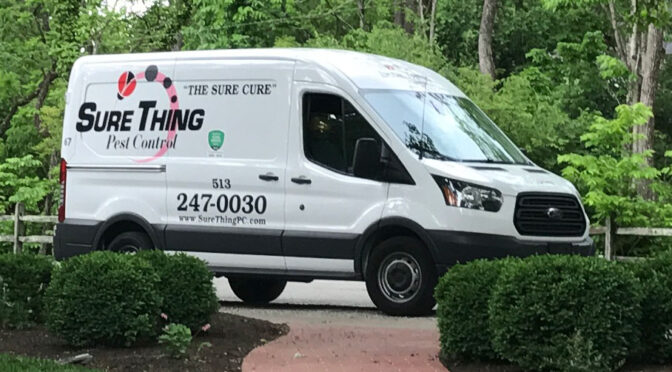
Sure Thing Pest Control white service van parked in a residential driveway.

Photograph the insect if you can do so safely, record where you saw it, and check nearby accessible crevices. Use the evidence below to decide what needs inspection.

What you see What it may mean What to do now
One roach on the ceiling, nothing else A wanderer or hidden activity; the sighting alone cannot distinguish them Photograph it, check nearby gaps and request identification
Repeated sightings high up A nearby travel route or hiding place Arrange an inspection and check accessible fan edges
Droppings with shed skins or egg cases A reproducing population may be nearby Arrange an inspection and avoid foggers
Musty, oily odor with roach evidence in several rooms A more extensive infestation may be present Request an inspection and treatment plan

Sure Thing Pest Control is locally owned and family-run, serving Greater Cincinnati and Northern Kentucky since 1997. We offer kid and pet friendly treatments and ongoing scheduled protection through The Sure Cure. For a free estimate, call 513.247.0030 or use the contact form; our cockroach extermination service page explains the residential service.

Frequently asked questions

Does seeing a roach on the ceiling mean they are living in the walls?

No, a single sighting does not establish where roaches are living. Repeated sightings combined with droppings or shed skins near openings make a hidden population more likely and warrant inspection.

What do cockroaches absolutely hate?

No scent or household repellent reliably clears an infestation. Removing accessible food and water helps, but established populations usually need targeted treatment at their hiding places.

How do I kill a roach on my ceiling?

If it is safely within reach, you can remove it with a vacuum hose rather than spraying overhead. Do not climb on furniture to reach it. Removing one roach does not address hidden activity, so photograph it first if possible and check for other evidence.

Are the treatments safe for kids and pets?

Sure Thing Pest Control offers kid and pet friendly treatments, but product-specific precautions still apply. Ask for preparation and re-entry instructions, and keep children and pets away from treated areas until those instructions allow their return.

Pest Control Programs vs One-Time Sprays in Hyde Park: Cost and Coverage

A pest control program is a scheduled plan to treat existing pests and prevent them from returning by treating the pests you already have and watching for new activity. For Hyde Park homes with recurring seasonal problems, especially older properties near Hyde Park Square or Ault Park, it can make more sense than a single visit. One isolated wasp nest may need only one treatment.

If you have tried everything and pests keep returning, check whether the treatment addresses their source. Another application will not close the gap mice use to enter your basement. Before buying recurring service, get the covered pests and visit schedule in writing.

Why does a spring treatment stop working by October?

Why Does a Spring Treatment Stop Working by October?, surethingpc.com

An exterior treatment has a limited protection window. Weather and ground contact wear down the residue on foundations and nearby soil. Depending on the product and conditions, protection may last weeks to a season, not an entire year.

As fall nights cool across Hyde Park, home to roughly 14,000 residents, mice look for shelter from the mature tree canopy along streets near Observatory Avenue and Erie Avenue. In historic homes with older stone or brick foundations, rodents enter through gaps around utility lines, mortar joints, or where siding meets the sill plate. Those openings may have been there all summer. A spring application does not close them.

Stink bugs also seek shelter as temperatures fall, often gathering on sunny exterior walls. Prevention needs to happen before they settle inside.

What should you compare before you choose?

Compare the work included, rather than the name of the plan. Ask these questions about either option:

  • How many visits are included, and when? Two spring visits do not provide a year-round service schedule.
  • What happens at each visit? Find out whether entry-point inspection or sealing is included alongside treatment.
  • Which pests are covered? Get their names, rather than relying on “general pest control.”
  • What happens if pests return? Confirm any additional charge and the length of any retreatment guarantee.
  • How does the agreement end? Read the renewal and cancellation terms before signing.

For a one-time job, confirm whether follow-up treatment is included. “One-time service” does not tell you what happens if the original problem remains.

How do the two options compare side by side?

Cost depends on the pest and the work needed to address it. Compare the total price over the agreement’s term, including any separately quoted exclusion work, rather than comparing a single-visit price with a monthly payment.

The 2025 Pest Control Industry Cost Study found that recurring revenue accounted for 74% of income among 246 surveyed U.S. pest management companies in 47 states. Recurring service is common, but that does not make it the right purchase for every home.

Criterion One-time spray or visit Scheduled program
Visit schedule Service for a defined problem; confirm follow-ups Recurring visits on an agreed schedule
Work performed Treatment directed at the identified pest Ongoing treatment and monitoring as specified
Coverage window Depends on the treatment and conditions Maintained through the period the agreement covers
Pests covered The pest named in the service agreement The pests listed in the plan
Sealing entry points Confirm whether included or quoted separately Confirm whether included or quoted separately
Additional visits Check the follow-up terms Check between-service charges and retreatment terms
Renewal and cancellation Check for any continuing obligation Read automatic-renewal and cancellation provisions
Cost comparison Total price for the defined job Total price over the agreement’s term

When is a one-time visit the right call?

A single wasp nest under an eave may call for one targeted service, not year-round treatment. An isolated ant problem may also suit a one-time visit if the source can be identified and addressed.

  • The advantage: you pay to address a defined problem without committing to recurring service.
  • The limitation: treatment for that pest does not provide protection against next season’s problems.

Ask for an inspection-based recommendation rather than assuming every sighting needs a program. Our bee and wasp control and ant control pages explain those services.

What does a program cover through the four pest seasons?

Hyde Park’s seasonal concerns include spring swarmers, summer stinging insects, fall overwintering bugs, and winter rodents seeking shelter in older basements. A recurring plan should explain when inspections happen and which of these pests it covers. Year-round service does not automatically mean every pest is included.

The Sure Cure provides ongoing scheduled protection. Confirm its covered pests and treatment schedule before signing, and ask whether any exclusion work requires a separate quote. A recurring pattern, such as mice each fall, warrants attention to entry points as well as treatment.

Sealing the entry points

A mouse sighting tells you to look for an entry route. Exclusion means closing those routes so rodents cannot keep coming back. Inspect foundation gaps and utility penetrations, then address mice already indoors through trapping.

Do not indiscriminately seal building openings designed for ventilation or drainage. Ask what material will be used and how the repair preserves the opening’s function. Our rodent exclusion and mice infestation control pages explain this work.

Monitoring and interior trapping

Mice reproduce quickly, so removing one does not establish that an infestation is over. Trapping and continued checks help determine whether activity has stopped after entry points are addressed.

Avoid sweeping or vacuuming dry droppings, which can put contaminated particles into the air. Use appropriate disinfectant and gloves for cleanup, and seek professional guidance for extensive contamination or affected insulation. Our rodent control and stink bug control pages cover these different shelter-seeking pests.

How long does an exterior barrier actually last?

There is no single lifespan for every exterior treatment. The product and how much weather the surface gets both affect how long it remains effective. A protected application beneath an overhang does not face the same conditions as an exposed foundation.

Ask when reassessment or retreatment is due. That interval should follow the product label and conditions at your property, not a blanket promise that one spring treatment lasts through October.

What happens when pests come back between visits?

The agreement should say whether additional visits are included for covered pests. If they are not, ask what they cost. Also check how long any retreatment guarantee lasts and whether a different pest requires separate service.

Report new activity with its location and date. Mice appearing in an attic after basement trapping may require a different inspection route, rather than simply repeating the original treatment.

What should you ask before you sign a program?

What Should You Ask Before You Sign a Program?, surethingpc.com

A written scope is the document you keep after the sales call, so it should answer your questions without anyone having to remember what was said. Go through the points below before you sign, and get any answer that is not in writing added to the agreement.

  • When are the scheduled visits? Check which seasons the agreement covers.
  • Are your pests named? Do not assume termites or rodents are included.
  • Is exclusion included? Ask which openings will be addressed and what costs extra.
  • What happens between visits? Check charges and retreatment conditions.
  • How do you cancel? Read any notice requirements and automatic-renewal terms.
  • What precautions apply? Get product-specific instructions for children and pets before treatment.

Once those answers are in writing, the choice between a program and a one-time visit gets simpler. A single page that names the pests, the visits and the exit terms tells you more than a lower first price does.

Which option fits your home?

Use the pattern of activity to guide the decision:

  • One isolated, identified problem: consider targeted service.
  • Pests returning season after season: consider recurring protection that addresses the source.
  • Mice inside walls or signs of wood-destroying insects: start with a professional inspection.

Tell the technician where you found activity and when it started. Photos can help distinguish a single event from evidence of an established infestation.

Sure Thing Pest Control has been locally owned and family-run since 1997. The two owners bring over 80 years of combined experience, and our background-checked technicians complete over 40 hours of additional training annually. You can meet the team. For a free estimate on the problem at your home, call 513.247.0030 or describe it through our contact page.

Frequently asked questions

How much does a one-time pest control treatment cost compared to a scheduled program?

The price depends on the pest and the scope of work, so a single number would mislead you. Compare the one-time job’s total cost with the program’s total cost over its agreement term, including any separate exclusion charges. Sure Thing Pest Control offers free estimates.

What is included in The Sure Cure recurring protection plan?

The Sure Cure provides ongoing scheduled pest protection. Confirm the covered pests and visit schedule in the written agreement, and whether sealing is included. The pest control programs page provides an overview.

Do I have to pay again if pests come back between scheduled visits?

That depends on your agreement and whether the returning pest is covered. Check whether additional visits are included, along with any charges or retreatment deadlines. Do not assume every return visit is free.

How long does an exterior pest control barrier actually last?

Exterior treatments may provide protection for weeks to a season, depending on the product and exposure. Weather and the treated surface affect performance. Ask your technician for the label-based retreatment interval appropriate to your property.

Are pest control program treatments safe for kids and pets?

Sure Thing Pest Control offers kid and pet friendly treatments, but precautions still apply. Ask where products will be placed and how long children and pets must stay away from treated areas. Follow the product instructions on drying time and when it is safe to re-enter.