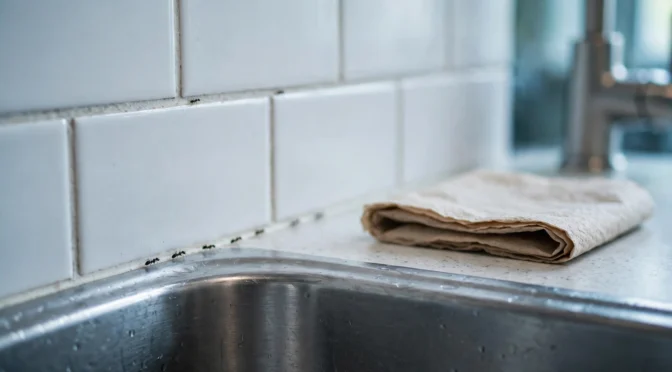
Professional ant control services start with finding where ants enter and treating the colony, not just killing the workers on your counter. Baits and non-repellent treatments let foraging ants carry material back to the nest. If you have tried everything and the kitchen trail keeps returning, the colony may still be untouched.
Why Dead Ants on the Counter Don’t Mean the Problem Is Gone
The ants crossing your backsplash are usually foragers searching for food and water. Killing them tells you little about the nest, which may be hidden inside a wall or outside near the foundation.
A contact spray can kill the workers it touches without reaching that nest. Another trail appears near the dishwasher because the colony still has access to food and moisture. Count fewer ants if you like, but don’t mistake that count for proof that the colony is gone.
Why a Repellent Spray Can Split One Colony Into Several
Ants can detect repellent products and avoid treated surfaces. Spraying an indoor trail can scatter workers, sending them toward another route rather than solving the problem at its source. In some species, disturbing a colony can also encourage groups to establish separate nests, a process called budding.
That does not mean every sprayed trail becomes several colonies. It does mean repeatedly spraying a kitchen trail can make the problem harder to follow and treat. Stop adding repellent spray where ants are feeding on bait.
Contact Repellents and Non-Repellent Treatments Do Opposite Jobs
A contact spray targets exposed ants. A non-repellent treatment is designed to go unnoticed, allowing workers to pick up material and carry it back to the colony. Product choice and placement determine whether that transfer can happen.
| What to compare | Contact repellent spray | Non-repellent transfer treatment |
|---|---|---|
| Can ants detect it? | Ants can detect and avoid repellent material | Formulated to go unnoticed |
| What happens to ants that touch it | Exposed ants may die; surviving workers may scatter | Workers can pick up material and carry it back |
| Where it travels | Primarily treats the sprayed surface and exposed ants | Can move through the colony by transfer |
| Effect on the nest | May leave the nest untouched or disturb it | Intended to reach the colony beyond visible workers |
| How it is placed | Applied to surfaces permitted by the label | Applied at selected travel routes or entry points, as the label permits |
Non-repellent treatments and baits are not interchangeable. Baits attract ants to food containing a slow-acting material; non-repellent treatments rely on ants crossing a treated area.
How a Bait Travels From a Forager to the Queen
Bait uses the workers’ food-sharing behavior to reach ants you cannot see:
- A forager finds an attractive bait and feeds on it.
- The worker returns to the nest with the material.
- It shares food with nestmates.
- The material moves through the colony and can reach the queen.
Baits act slowly on purpose.
Workers need time to share the material through the colony before it is eliminated. More ants gathering at a bait station can mean they have found it, not that the infestation has suddenly grown.
Don’t judge a bait by the number of ants visible the next morning. Follow the label’s directions for monitoring and replacement, and tell your technician if activity changes rather than spraying over the bait.
Is Professional Ant Treatment Safe Around Kids, Pets and Food Prep Areas?
Ask where the material will go and how children and pets will be kept away from it. A secured bait station in an inaccessible location limits access, but placement must follow the product label. Kid and pet friendly does not mean a product can be handled freely.
Sure Thing Pest Control offers kid and pet friendly treatments. Before treatment, ask what needs to stay clear and whether there is a drying or reentry period. Follow the label and your technician’s written instructions.
Don’t use bleach or ammonia as ant treatments. Neither reaches the nest, and mixing household cleaners can create dangerous fumes. Keep food-preparation surfaces clean, but avoid disturbing an active bait placement.
Our technicians are background checked and complete over 40 hours of additional training each year. Ohio and Kentucky license pesticide applicators through their departments of agriculture. You can read more about our licensing and training on the credentials page.
What Repeated Cans Cost Compared With One Inspection
Add up what you have spent on sprays and replacement bait, along with the time spent treating returning trails. A store-bought bait can be a reasonable choice for a light problem. Repeated purchases without finding the entry point are a different calculation.
An inspection should establish where ants are entering and what is attracting them. The treatment needed depends on those findings, not simply on how many ants happen to be on the counter that day.
Sure Thing Pest Control offers free estimates. Call 513.247.0030 or send a request through the contact form. Our ant control page explains our inspection and extermination services.
Where Ants Get In and When to Call a Professional
Follow the trail backward before disturbing it. Start beneath the sink, then check nearby plumbing penetrations and damp areas. Useful places to inspect include:
- Drain lines and openings beneath the sink
- The dishwasher’s water supply
- Pipes or wires passing through a wall or slab
- Pet feeding areas where food remains overnight
- Leaks that leave a surface damp
Fix drips and store food in sealed containers.
Around older Greater Cincinnati and Northern Kentucky homes, damp foundation edges and utility openings deserve attention. The opening ants use may be well away from the kitchen where you first notice them.
As overnight temperatures drop in October, ants still foraging may find indoor food sources. Don’t assume cooler weather will resolve an established indoor trail. Arrange an inspection if you notice:
- Ants appearing in several rooms
- Large numbers of winged ants indoors
- Wood dust or wood that sounds hollow
Wood dust can point to carpenter ants, although an inspection is needed to identify the cause. Carpenter ants tunnel through wood and require a different treatment plan from a small household ant trail. Our carpenter ant page explains that service.
We serve Cincinnati, Lebanon and Springboro in Ohio, plus Burlington and Ft Mitchell in Kentucky. Check our service areas page for coverage. If you want scheduled prevention after the immediate problem is addressed, ask about The Sure Cure on our pest control programs page.
Frequently asked questions
What do exterminators use to get rid of ants?
Professionals may use baits or non-repellent treatments, depending on the ant species and where the colony is active. Workers can carry these materials back to the nest, reaching beyond the ants visible indoors. Inspection determines which approach and placement fit the problem.
How much does professional ant control cost in Cincinnati?
The cost depends on how many entry points the inspection finds and whether the colony is inside a wall, under a slab or outside near the foundation. Sure Thing Pest Control offers free estimates. Call 513.247.0030 and describe where you are seeing ants and what you have already tried.
How do I choose an ant control company in Cincinnati?
Choose licensed technicians who explain how they will find the entry points and treat the colony. Sure Thing Pest Control has been locally owned and family-run since 1997, and the owners bring over 80 years of combined pest control experience. Our licensed, certified technicians are background checked and complete over 40 hours of additional training annually.
Is a store-bought bait enough for a light kitchen ant trail?
A store-bought bait can help control a light trail if ants accept it and you follow the label. Don’t spray repellent products around the bait, because that can interfere with feeding. If trails persist or appear in several rooms, arrange an inspection rather than repeatedly changing products.
Are professional ant treatments safe for kids and pets?
Sure Thing Pest Control offers kid and pet friendly treatments, with safety depending on proper product use and placement. Ask your technician about keeping children and pets away from treated areas and bait stations, including any required drying or reentry period. Follow the product label and the technician’s written instructions.