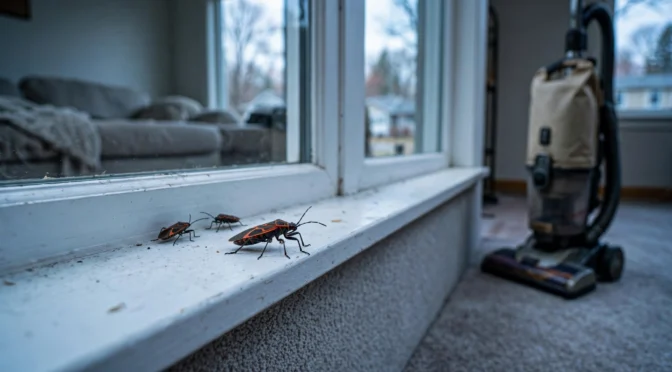
To get rid of boxelder bugs in your Fairfield home, vacuum the ones indoors without crushing them, then seal entry gaps before late August. They do not reproduce indoors. Spraying inside will not clear the bugs sheltering in walls; physical removal handles the ones you see, while sealing reduces the next fall’s invasion.
If red and black bugs keep collecting at the same sunny window, you do not need to spray each time they appear. Start with removal now and plan exterior repairs before the end of August.
Why do boxelder bugs gather on the sunny side of the house?
Adult boxelder bugs are about half an inch long and black with orange or red markings. Look for three stripes behind the head and wings that overlap in an X. Newly hatched nymphs are about a sixteenth of an inch long and bright red.
South- and west-facing walls hold warmth and attract adults seeking winter shelter. Building color does not affect their choice. According to University of Minnesota Extension, adults can fly several blocks and sometimes as far as two miles, so the source is not necessarily a tree in your yard.
They feed mainly on female, seed-bearing boxelder trees, though they also feed on maple and ash without noticeable injury. If identification is uncertain, check the body shape: boxelder bugs are narrow, while stink bugs have a broader, shield-shaped body.
How do you remove them now without crushing or staining?
Crushing boxelder bugs releases an unpleasant odor and can leave marks. Their droppings can also stain fabric, so remove them promptly rather than brushing them onto curtains or carpet.
- Choose a cool part of the day. Remove bugs while they are less active, before afternoon warmth gets them moving.
- Use a bagged vacuum. Bring the nozzle close enough to collect each bug without pressing it against the surface.
- Avoid crushing them. On delicate surfaces, gently guide the bug onto a card for removal.
- Remove the vacuum bag outside immediately. Bugs left inside can escape, and dead insects can attract carpet beetles.
- Seal the vacuum bag in plastic. Put it in an outdoor trash bin.
- Clean after removal. Wipe the empty window casing with a damp cloth rather than wiping over live bugs.
Vacuum and bag
Check the window track and nearby crevices as you vacuum. Repeat when more bugs emerge on mild days. Another bug at the glass does not mean the vacuuming failed; it means another sheltered adult has become active.
What not to do
Do not crush bugs against the window or spray indoor surfaces with soap or vinegar. Neither liquid reaches the insects inside the wall, and both add cleanup to the job. Remove dead bugs rather than leaving them in an indoor bin.
Why do they keep showing up at the glass through winter?
Boxelder bugs seen indoors during winter and spring entered the previous fall. They do not breed inside, so repeated sightings are not evidence of a growing indoor colony.
Adults usually remain inactive in winter shelter. On mild, sunny days, some become active and move toward windows. University of Minnesota Extension notes that these active indoor bugs live only a few days to a week; that does not mean every adult sheltering in a wall dies within a week of entering.
Physical removal is the only practical indoor control. Treating wall voids is not practical, because the insects sit deep in the wall where a product cannot be placed reliably. Spraying the siding does not clear insects already sheltering behind it. Vacuum what you find, seal the bag, and put your effort into the entry points.
What needs sealing before the end of August?
University of Minnesota Extension recommends finishing repairs before the end of August. For your Fairfield home, use that as a planning deadline rather than waiting until bugs cover a sunny wall.
- Seal openings 1/8 inch or larger in masonry or stucco with a suitable exterior caulk, such as silicone.
- Use an appropriate larger-gap material, such as copper mesh or expandable foam, where suitable for the opening.
- Close gaps around utility lines and pipes, including openings around outdoor faucets and dryer vents. Keep vent outlets unobstructed.
- Repair damaged window, door and vent screens.
- Check exterior door sweeps and the rubber seal along the bottom of the garage door.
Older houses with vinyl siding can have too many small gaps to exclude every bug. Repairs still reduce entry, but complete exclusion is harder than it is in a tighter house.
Gaps to close by hand
Start around window frames and utility penetrations, especially on sunny walls. Choose a sealant suited to the materials and gap size. Do not fill every visible opening indiscriminately; some openings drain or ventilate the wall.
Weep holes you leave open
Weep holes at the bottom of brick or stone veneer allow moisture to drain. Leave them open, or fit ventilation plugs designed for weep holes. Caulking them shut can trap moisture inside the wall.
Screens and the August deadline
Include roof and soffit vent screens in the inspection, not just window screens. Check bathroom and kitchen exhaust screens where fitted. Arrange help for openings you cannot safely reach, rather than leaving those repairs until fall.
When does exterior treatment help next fall, and when is it wasted?
Exterior treatment is most useful during fall movement, before adults enter shelter, and when paired with sealing. It is not a substitute for closing gaps.
Once bugs are already inside for winter, spraying siding does little for them. If those are the insects you want removed, do not pay for an exterior spray expecting it to do the vacuum’s job.
When exterior work pays off
Ask the technician which entry points need repair and how treatment timing matches activity on your home. The plan should account for the south- and west-facing walls where bugs gather, rather than relying on a calendar date alone.
When it is wasted
An exterior application will not clear sheltered bugs from wall voids. For any treatment, ask for the product label and follow its directions for keeping children and pets away during application and reentry. Professional application does not make a pesticide risk-free.
The related exclusion advice also helps explain why outdoor stink bug treatment does not replace closing entry points. Confirm which insect you have before choosing a treatment.
When should you stop vacuuming and call a professional?
Ask for professional help when the number of bugs is too much to manage or entry points are beyond safe reach. Continued sightings after sealing do not necessarily mean the repairs failed; adults already inside can still emerge.
We serve Fairfield as part of Greater Cincinnati. Sure Thing Pest Control is locally owned and family-run, and the owners bring over 80 years of combined pest control experience. Our technicians are background checked and complete over 40 hours of additional training annually.
For help planning pest control around recurring fall entry, request a free estimate or call 513.247.0030. You can review our pest control credentials before scheduling.
Frequently asked questions
How do I permanently get rid of boxelder bugs?
Seal entry openings before fall and vacuum any bugs already indoors. Timely exterior treatment can support exclusion, but no spray closes a gap. Older vinyl-sided homes can remain difficult to seal completely, so expect reduction rather than a promise of zero bugs.
Do boxelder bugs stain walls and curtains?
Yes. Crushing them can leave marks and releases an unpleasant odor, while their droppings can cause reddish stains on fabric. Vacuum them promptly without pressing them against the surface.
Will boxelder bugs go away after the first hard frost?
The first hard frost typically ends outdoor activity, but it does not remove adults sheltered inside a building. In October 2026, a University of Minnesota Extension educator described that frost-related outdoor die-off. Sheltered adults can still appear at windows on mild winter days.
Will soapy water or vinegar get rid of them?
Neither clears bugs sheltering inside walls. Soapy water can kill exposed bugs on contact, but it does not prevent more from entering; vinegar is not a dependable control. Vacuum indoor bugs and focus prevention on sealing entry points.
Do boxelder bugs bite or sting?
Boxelder bugs do not sting and are not normally a biting pest. Their piercing mouthparts can puncture skin and leave a small, irritated red spot. Avoid handling or crushing them with bare hands.