Category Archives: Ants in Cincinnati

Will Lysol Kill Ants in Blue Ash? What Sprays Can and Can’t Do

Lysol can kill ants it touches, but it will not eliminate the colony. It is a surface disinfectant, not a labeled ant treatment. For ants returning to your kitchen, bait is usually the better choice because foragers carry it back to the nest, where contact spray cannot reach.

If you have tried everything to keep ants off the counter, another trail can be frustrating. Before spraying again, watch where they enter. That trail gives you a useful clue about the source.

Does Lysol Kill Ants on Contact?

Yes, but killing exposed workers is different from controlling an infestation. Lysol Disinfectant Spray is marketed as killing 99.9% of illness-causing germs on surfaces, not as an insecticide. That germ-killing claim does not establish how well it controls ants.

A direct spray can kill individual ants, but it does not deliver treatment to the queen or workers sheltered in the nest. Even a completely clear counter tells you little about whether the colony is still active.

Why Do Ants Return After Spraying?

Why Do Ants Come Back Bigger After Spraying?, surethingpc.com

Foraging ants leave pheromones, chemical signals that guide other ants toward food. Wiping the trail removes that route marker. Surviving foragers can establish another route, which explains why ants may appear somewhere else after you clean.

The nest also remains active. If the queen survives, she can continue producing workers. More ants after spraying are a reason to change the approach, not spray harder. Our ant inspection and treatment services address the infestation rather than just the visible trail.

What Is Colony Budding, and Can Spraying Cause It?

Budding happens when part of a colony separates to establish another nest. In species with multiple queens, disturbance can encourage this split. Odorous house ants are one example.

Repellent sprays can drive ants away from a treated spot without eliminating them. For species prone to budding, that disturbance can make treatment more complicated. Not every spray application creates new nests, but spraying the trail is a poor first choice when you do not know which ant you have.

Which Ants Invade Cincinnati Kitchens, and Which Ones Split?

Odorous house ants are common indoor ants in the Midwest. Their colonies can have several queens, which helps explain why treating only the workers on a counter may provide little lasting relief. Identifying the species matters before choosing a treatment.

For a Blue Ash homeowner, the practical inspection starts where the trail meets the building. Look closely at plumbing penetrations beneath the sink, then check accessible foundation gaps outside. Ants entering through an opening do not necessarily nest beside it; follow the route as far as you safely can.

Argentine ants also form multi-queen colonies, but their behavior should not be used to identify ants in your kitchen. A study about that species can explain how bait works without proving that the ants in your home are Argentine ants.

What Should You Do Instead When Ants Show Up on the Counter?

Remove competing food and find the entry route before choosing a product. Avoid spraying ants you intend to bait, since the foragers need to survive long enough to carry bait back.

  1. Put food in closed containers and wipe up sticky spills. Pick up leftover pet food rather than leaving it available to foragers.
  2. Follow the trail to its entry point. Check around plumbing and inspect accessible gaps along the foundation.
  3. Clean food-contact surfaces with soap and water. This removes trail signals, but it does not treat the nest.
  4. Use an ant bait according to its label if activity continues. Keep spray cleaners away from the bait and its approach route.
  5. Seal accessible entry gaps as part of prevention, and keep monitoring for activity elsewhere.

Vinegar can remove trail signals, but it will not eliminate a hidden colony. Diatomaceous earth kills insects by absorbing oils from their outer covering; its dust can irritate airways and should not be inhaled. Neither is a substitute for reaching the source of a recurring infestation.

How Long Does Ant Bait Take, and Is It Safe Around Pets?

Expect several days to a couple of weeks before activity drops, depending on the colony and product. Slow action is the point: foragers need time to carry the material back and share it. A product that kills them before they return cannot do that job.

A University of California, Riverside study published in 2026 found that Argentine ant workers exposed to thiamethoxam bait became unusually active outside the nest before dying. Boric acid bait produced different behavior and killed about 90% of workers within roughly two weeks. Those were findings for the studied ants and conditions, not a promise for every household infestation.

More ants around bait usually mean they are feeding on it. That alone does not mean the treatment has failed.

Watch the trend over several weeks, not the first busy afternoon.

No insecticide should be treated as harmless around children or pets. Read the label before buying, use only the permitted placement, and keep bait inaccessible to children and animals. Keep it away from food-preparation surfaces, and store unused product securely.

When Should You Stop Treating Ants Yourself and Call a Pro?

Sure Thing Pest Control white service van parked in a residential driveway.

Ask for an inspection if ants keep returning after two or three weeks of consistent baiting and cleanup. Call sooner if they repeatedly emerge from wall or floor openings you cannot inspect. Those routes can conceal nesting sites that require a different approach.

Suspected carpenter ants also warrant an inspection because they excavate wood and can damage it. Our carpenter ant extermination page covers treatment for that problem.

Sure Thing Pest Control is locally owned and family-run, operating since 1997. Our owners bring over 80 years of combined pest control experience. We offer kid and pet friendly treatments for homes and commercial properties, with ongoing scheduled protection available through The Sure Cure.

If ants keep returning in your Blue Ash home, call 513.247.0030 for a free estimate or request an ant-control quote. Tell us where the ants appear and which products you have already used.

Frequently asked questions

Does Lysol kill ants instantly?

Lysol can kill ants on contact, but you should not expect a guaranteed instant result. It is a surface disinfectant, not a labeled insecticide, and it does not eliminate the hidden colony.

Will spraying Lysol keep ants from coming back?

No, spraying Lysol is not a reliable way to prevent returning ants. It may remove trail signals, but surviving ants can establish new routes while the colony remains active. Removing food sources, using appropriate bait and sealing entry gaps offer a better approach.

How long does ant bait take to work?

Ant bait can take several days to a couple of weeks before activity drops. Foragers must carry the slow-acting material back to the colony, so increased activity around fresh bait can be normal. Seek an inspection if ants continue returning after two or three weeks of consistent baiting and cleanup.

Are ant baits safe for pets and children?

Ant baits must be placed and stored where pets and children cannot access them, following the product label. A bait station is not permission to leave insecticide within reach. Sure Thing Pest Control offers kid and pet friendly treatments if you prefer professional treatment.

Sugar Ants vs Carpenter Ants: How to Tell Them Apart

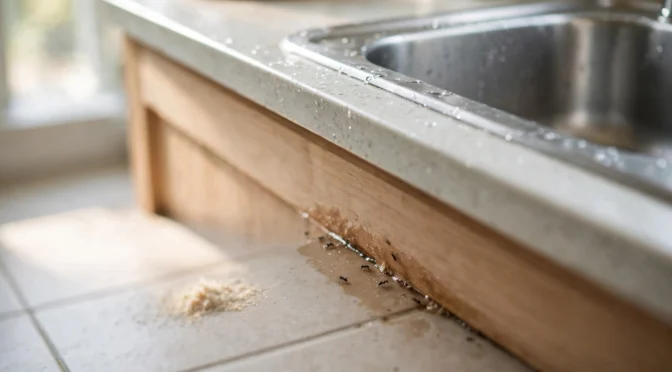
“Sugar ant” means a sweet-seeking ant, not a particular species. Carpenter ants can visit the same sugar bowl, but they are larger than most kitchen ants and can nest in wood. Size is your first clue; recurring sawdust-like debris is a reason to check for a nest.

If you have tried everything and ants keep returning behind the sink, check for moisture before buying another product. A small kitchen trail is not automatically a structural problem. Large ants near damp wood, especially with fresh debris beneath it, deserve closer inspection.

Start With Size, Not the Name

Carpenter ant workers measure roughly 9.5 to 12.7 mm long. Odorous house ants measure about 2.4 to 3.3 mm, according to Bob Vila’s home-improvement guide, updated May 31, 2023. That difference is easier to judge than the tiny details of an ant’s waist.

Photograph an ant beside a ruler or coin. If you need magnification just to make out its body, it is probably not a carpenter ant. ScottsMiracle-Gro’s undated explanation of “sugar ants” confirms that the term covers several sweet-seeking species, including carpenter ants. The label on a bait box does not identify your infestation.

Does the Ant Have One Node or Two?

Start With Size, Not the Name Sugar Ant, surethingpc.com

Carpenter ants have one node, a small segment at the waist between the middle body and abdomen. Some small household ants have two, but others also have one. Node count can narrow the identification; it cannot confirm carpenter ants by itself.

You need a still ant and magnification to see that detail. Start with body size and where you found it.

Color Does Not Settle It Alone

Carpenter ants can be black or have reddish coloring, and many small household ants are dark too. A black ant on the counter is not enough evidence to choose a treatment.

Check the Wings on Winged Ants

Ants have front wings longer than their back wings; termites have four wings of roughly equal length, as Bob Vila’s May 31, 2023 guide explains. Winged ants indoors in spring can indicate a mature nest nearby. Save a specimen or take a clear photo for identification.

Do Carpenter Ants Eat the Wood or Clear It Out?

Carpenter ants clear out wood to make nesting galleries. They eat other foods, including sweets and insects, rather than the wood itself. Repeated excavation can still weaken structural wood over time.

Subterranean termites eat wood and often leave soil inside damaged areas or mud tubes along foundations. Carpenter ant galleries are generally clean. Mud tubes call for a different inspection, covered on our termite inspections and control page.

What Does the Sawdust Actually Look Like?

What Does the Sawdust Actually Look Like?, surethingpc.com

Carpenter ant debris, called frass, contains wood fibers and may include insect parts. Look for a small pile beneath an opening in wood or along a baseboard. Photograph it before cleaning, then watch whether fresh material appears in the same place.

Debris What it looks like Where it usually collects
Carpenter ant frass Sawdust-like fibers, sometimes with insect parts Beneath an opening in wood or along a sill or baseboard
Subterranean termite evidence Soil or mud tubes Foundations and routes between soil and wood
Drywood termite pellets Small, hard pellets Below openings in infested wood
Household dust Fine particles without recognizable wood fibers Exposed surfaces and corners

Why Is Sawdust Showing Up by the Sink?

A plumbing leak can soften wood and make it suitable for carpenter ant nesting. Finding ants does not prove there is a leak, but fresh debris beneath a sink makes the plumbing worth checking.

Look for moisture without taking the cabinet apart:

  1. Check supply lines and the drain for drips or water stains.
  2. Look for swollen cabinet flooring or accessible wood that feels soft. Avoid puncturing it or probing near pipes and wiring.
  3. Check nearby window sills for peeling paint or persistent dampness.

Greater Cincinnati’s humid summers and seasonal rain make moisture control especially relevant around older crawlspaces and wood framing. Repair the water source as part of addressing the nest. Ant treatment cannot repair a leaking drain.

Where Do Carpenter Ants Build Their Nests?

A colony may have a parent nest outdoors in decayed wood and satellite nests inside the building. Indoor nests can occupy wall voids or spaces behind tubs. The ants on your counter may be foraging well away from the nest, so treating that counter alone can miss the source.

Trim branches touching the house and store firewood away from the foundation. Wood in contact with siding or the roof can give ants a route indoors.

Why Sweet Bait and Sprays Can Miss the Nest

Bait can work when foraging ants carry an appropriate product back to the colony. It is not guaranteed: food preferences and placement matter. Killing visible workers with spray may leave the nest untouched, and some sprays can cause colonies to scatter.

For more on choosing between approaches, read our piece on ant control services vs DIY sprays, or see our ant control in Cincinnati. Confirm the ant before choosing a product, especially when wood debris is present.

When Should You Stop Guessing and Call a Professional?

Arrange an inspection when fresh frass returns or large ants repeatedly emerge from the same wall opening. The inspection should trace activity toward the nest and check nearby moisture, rather than stop at the visible trail.

Signs That Need an Inspection

These signs warrant a closer look, even if you see only a few ants:

  • Fresh debris appears after you clean the area.
  • Trails persist after obvious entry gaps are sealed.
  • Accessible wood feels soft or appears damaged.
  • Framing near plumbing remains damp.

Avoid pulling trim or drilling into walls to find the colony. You can damage concealed plumbing or wiring and still miss the nest.

What to Note Before the Visit

A few observations help the technician follow activity without unnecessary disturbance:

  • The opening where ants enter the room.
  • The location of recurring debris.
  • Nearby leaks or damp wood.
  • A clear photo with a coin or ruler for scale.

Treatment may require access to crawlspaces or wall voids and follow-up visits. Sure Thing Pest Control is locally owned and family-run, serving Greater Cincinnati and Northern Kentucky since 1997 with kid and pet friendly pest control. For a free estimate, call 513.247.0030 or visit our carpenter ant exterminators page.

Frequently asked questions

What is the difference between sugar ants and carpenter ants?

“Sugar ant” is a general name for ants attracted to sweets, and carpenter ants can fit that description. Carpenter ants are larger than many common kitchen ants and excavate wood for nests. Recurring sawdust-like debris is more useful evidence than an attraction to sugar.

Can carpenter ants cause structural damage to my house like termites?

Yes, established carpenter ant nests can weaken wood over time. They excavate it rather than eat it, while termites consume wood. Finding a few foraging ants does not establish that structural damage has occurred.

How do you know if you have carpenter ants or regular house ants?

Start with size: carpenter ant workers are roughly 9.5 to 12.7 mm long, considerably larger than odorous house ants. Look for recurring wood debris near their activity. A specimen or clear photo helps a professional confirm the species.

Are pest control services worth it for ants?

An inspection is worthwhile when ants keep returning or activity occurs beside damaged wood. Small household-ant trails may respond to sanitation and properly selected bait. Suspected carpenter ant nesting needs attention to the nest location and any moisture source.

Should I open the wall to find the nest myself?

No. Opening walls can damage concealed utilities without locating the colony. Record where ants emerge and photograph any debris so a technician can decide where access is needed.