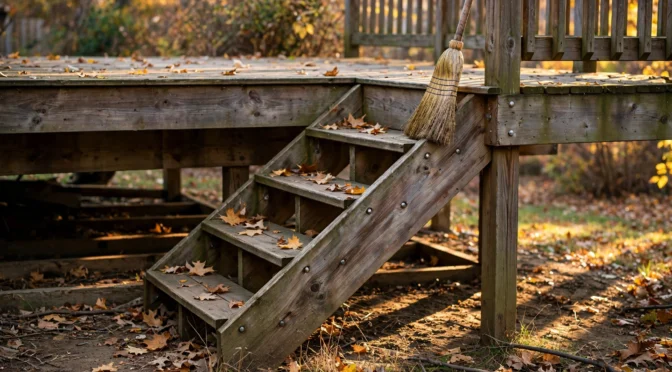
A soft spot on a deck is a reason to stop what you are doing, not a reason to reach for the stain can. The wood under your foot may be rotting from water, or termites may be eating it from the inside, or both. The fastest way to tell is a probe: push a flathead screwdriver gently into the suspect wood and compare it with sound wood a few inches away. If the screwdriver goes past the surface, the wood is already compromised, and a licensed pest professional should look at it before you do anything else.
Signs of termites in a deck usually show up at the points where wood meets soil: the ground line of each post, the post base, the top of each concrete pier, and the stair stringers. Termites eat wood from the inside out, so a board can look firm from above while the inside is hollow. That is why a visual check alone is not enough, and why every post and stringer that touches the ground needs to be checked.
Why a Soft Stair Stringer in October Calls for a Probe, Not a Brush
Think about the usual autumn routine. You are clearing maple leaves off the deck stairs, one foot comes down on the stringer, and it gives a little more than it should. The instinct is to sand it and seal it before the first freeze. That instinct makes sense for a weathered board, but it skips the question that matters: what is causing the softness?
Fungal rot and subterranean termites both leave wood that feels wrong, and from the top they can look almost identical. Termites are the one that hides. WebMD notes that termites eat wood from the inside out, so infested wood often looks normal on the outside, and serious damage usually takes three to eight years to develop. A clean-looking stringer can still have a lot of damage behind the surface. Test before you treat.
Find Every Post and Stringer in Contact With Soil First
Before you start poking, make a quick list of the wood that is most likely to be involved. Subterranean termites are the most common type across most of the United States, and they live in soil and in wood connected to soil. In Greater Cincinnati and Northern Kentucky, summer humidity and seasonal rain keep the ground around deck posts damp for long stretches, which is exactly the condition that holds moisture against wood. Walk the deck and mark:
- Every post set in soil or in a concrete footing that sits at grade.
- Every stair stringer that rests on the ground or sits close to it.
- Any wood buried in or touching mulch or landscape edging.
- Firewood stacked against the deck or the house.
- Any spot where deck framing touches the house wall.
Firewood and mulch matter more than most people expect. Wood that touches soil, or that sits against the house, gives termites a direct path from the ground into the structure. Wood that stays wet for weeks, as wood under a downspout line or in shade does, is easier for both rot and termites to work on.
Probe the Ground Line, Post Bases and Pier Tops
The probe itself takes about ten minutes. You need a flathead screwdriver and a bit of patience. Work in this order so you are comparing like with like:
- Start at the spot that gave way, usually a stringer or the bottom of a post.
- Push the tip gently into the wood at the ground line. Do not stab or lever. Let the tip find its own way.
- Repeat at the post base where the post meets the bracket or pier.
- Check the top of each concrete pier, where it meets the wood.
- Move outward from the damaged spot to sound wood, and probe a few inches away from the suspect area.
- Compare the feel. Sound wood resists the tip. Suspect wood gives way.
The point is contrast. A soft spot means little on its own, because weathered wood feels soft at the surface everywhere. What matters is whether the suspect area is noticeably softer than the wood right next to it. If the screwdriver goes in past the surface layer, that is the signal to stop and call. The EPA recommends this same first detection step, probing exposed wood for hollow spots with a flathead screwdriver or similar tool.
Tell Fungal Rot From Termite Galleries
Once you have a probe result, the next question is what it means. Fungal rot and termite damage look different when you know what to look for. Use this as a reading guide, not a diagnosis. A pro confirms it.
| What you see or feel | Fungal rot | Subterranean termite damage |
|---|---|---|
| Texture on the surface | Soft and spongy throughout the affected area | Firm outside, with a thin shell of wood left on top |
| Colour | Darkened, often brown or grey, stringy | Wood colour is near normal on the outside |
| How it breaks | Crumbles in cubes or pulls apart along the grain | Gives way suddenly once the outer shell is breached |
| Inside the wood | Uniform decay with no defined tunnels | Smooth-walled galleries tunnelled along the grain, often packed with soil or mud |
| Where it sits | Worst where water sits: post bottoms, under downspouts, low spots | Where wood touches soil or the foundation, often in hidden spots |
Rot follows moisture and tends to be widespread in a damp area. Termite damage can be patchy and hidden, with the tunnels doing most of the work. If you open a suspect board with a pry bar and see packed soil or mud in smooth tunnels, that is a strong sign of termites, not rot.
Check the Mud Tubes on Piers, Post Bases and Stair Skirts
Mud tubes are often the most visible sign, and the one people most often miss because they are in shaded spots. Subterranean termites build these tubes from soil and wood particles to travel safely between their colony and their food. WebMD notes they are often found on foundation walls, fences, sheds, cracks between boards and crawl spaces.
On a deck, look at these spots in particular:
- The concrete pier, especially the shaded gap where the post meets it.
- The post base and the bracket around it.
- The edges of footings and the underside of stair stringers.
- The stair skirt and any space under the stairs.
- Cracks between boards and along the joints where wood meets masonry.
A mud tube is a route map. It shows where the colony is travelling, which is why it matters more than the damage itself. If you see one, photograph it with a coin or ruler for scale, and leave it in place. Knocking it down does not remove the colony, and the termites will rebuild it. A technician needs to see where the tube starts and where it runs.
Inspect the Ledger Board From Both Sides
The ledger board, where the deck bolts to the house, is the highest-stakes spot on the whole structure. It is the joint where deck wood meets house framing, and it is the point where a deck problem can become a house problem. If there is a gap, or if the flashing has failed, wood can sit against wood or soil at that joint. That gives termites a bridge toward the band joist and then the subfloor. WebMD also notes that termites can enter through cracks in concrete and seams where plumbing and electrical lines run, so the house side needs checking too.
Inspect the joint in two passes:
- From the deck side: Look along the ledger for gaps between the ledger and the house wall, for flashing that is torn, missing, or lifting, and for soft or darkened wood where the ledger meets the house. Probe the lower edge of the ledger where it sits closest to the ground.
- From the house side: Check the rim joist or band joist behind the ledger. Look for mud tubes on the foundation, cracks in the masonry, staining, and any soft wood. If you can access a basement or crawl space, check the subfloor and joists directly above the ledger.
You are not trying to diagnose the whole house from this inspection. You are looking for evidence that the deck and the house are connected by damaged wood or open paths. If you find either, that is a call to a licensed inspector, not a weekend repair.
What Most People Skip on a Deck Check
Most homeowners do a reasonable job on the obvious spots and still miss termites. These are the mistakes that matter most:
- Waiting for frass. Pellet-shaped droppings are characteristic of drywood termites. Subterranean termites, the common type in this region, usually do not leave that kind of frass. On a deck with ground contact, do not wait for droppings to confirm an infestation. Mud, packed soil and hollow galleries are the more reliable signs.
- Trusting one clean board. A single sound-looking board does not clear the deck. Termites eat from the inside, so check every post and stringer that touches soil or sits near it.
- Knocking down the mud tube. It feels like progress, but it removes the evidence a technician needs and the colony rebuilds it anyway.
- Ignoring mulch, firewood and debris. Wood buried in mulch or stacked against posts holds moisture against the structure and creates a path from the ground.
- Confusing carpenter ants with termites. Carpenter ants excavate damp or softened wood to build nesting tunnels, and they can expand existing voids and speed up deterioration. They need a different fix, and they often appear where wood is already wet. Identify what you have before you treat it. Our carpenter ant extermination page covers that case.
General trade knowledge also says that a deck check done once in spring and forgotten misses the fall season, when many homeowners are cleaning up and noticing damage for the first time. Make the check part of your autumn routine.
What to Do If a Check Fails
If the probe finds soft wood, galleries or mud tubes, work through the steps below in order. The first two protect the evidence an inspector needs, and the last one gets a licensed professional on the job.
None of these steps asks you to dig, treat or diagnose anything yourself. They are about not making the damage harder to read or the situation worse while you wait for help.
- Stop the DIY work. Do not seal, stain, sand or replace boards over suspected damage. That hides the evidence and does nothing to a colony in the soil.
- Photograph everything. Take pictures of each probe spot and each mud tube, with a coin or ruler for scale. Note the location on the deck. This helps the inspector know exactly where to start.
- Keep weight off the affected area. Do not load the stairs or the deck near soft spots until someone has looked at them.
- Do not treat the soil yourself. Soil-applied termiticides and baits are licensed professional treatments. The EPA states that termiticide application can in most cases only be properly performed by a trained pest management professional, and that improper barrier treatment can contaminate the home and nearby drinking water wells and still fail to protect against termites.
- Book a licensed inspection. Sure Thing Pest Control is locally owned and family-run, operating since 1997, with owners bringing over 80 years of combined pest control experience. Technicians are licensed and certified, background-checked, and complete more than 40 hours of additional training each year. Call 513.247.0030 for an immediate free estimate, or request a quote through the contact page. You can learn more about the termite inspection and control service before you call.
What Actually Stops a Subterranean Colony
A fall stain or a surface sealer will not stop a subterranean colony. Coatings can slow the wood from drying out and make the deck look better, but they do not reach the soil where the colony lives. Treat them as maintenance, not termite control.
The EPA lists the approved treatment categories: liquid soil-applied termiticides, termite baits, termiticide-impregnated building materials, and wood treatments. The two common forms are conventional barrier treatments and termite baits. Baits use cellulose with a slow-acting insecticide, and they work by drawing the colony in over time. Which approach fits depends on the structure and what the inspection finds, which is why it belongs to a licensed professional.
Prevention is in your hands now, and it lowers the risk whatever treatment you choose. Based on EPA prevention guidance:
- Keep soil around the posts and foundation dry through grading and drainage.
- Keep gutters and downspouts working, and direct water away from the deck footings.
- Fill cracks in concrete and around utility penetrations.
- Keep trees and shrubs from growing against wood.
- Do not stack firewood or wood debris against the deck or the house.
- Fix leaks promptly, and keep vents clear.
Do these things this month, before the ground freezes and the chance to see the damage properly is gone. If your probe test found soft wood, mud or hollow galleries, the next step is an inspection, and the sooner that happens, the less of the structure is at risk. For a fuller picture of your options, see our guide to termite inspection and control options in Cincinnati.
Frequently asked questions
How is termite damage on a deck different from wood rot?
Termite damage feels firm on the surface and gives way inside, with smooth tunnels often packed with soil or mud. Rot is soft and dark, and it follows moisture. Compare suspect wood with sound wood a few inches away, then have a pro confirm.
Are mud tubes on a deck always a sign of termites?
Subterranean termites build mud tubes from soil and wood particles to travel between their colony and their food. Tubes on piers, post bases and stair skirts are a strong reason to call a licensed inspector. Photograph them and leave them in place rather than knocking them down.
Can termites from a deck get into the house?
Yes, through direct wood-to-home contact, through cracks and utility seams, and through the ledger joint where deck wood meets the house framing. Check that joint from both the deck side and the house side.
Does staining or sealing the deck stop termites?
No. Stain and sealer are cosmetic maintenance and do not reach the soil where a subterranean colony lives. Soil-applied termiticides and baits are licensed professional treatments.
What time of year are termites most active?
Subterranean colonies feed year-round in the soil, so damage can be progressing whatever the season. Many homeowners notice it during fall deck maintenance, which is a good time to check. If you have a specific concern about timing, ask the inspector when you call.