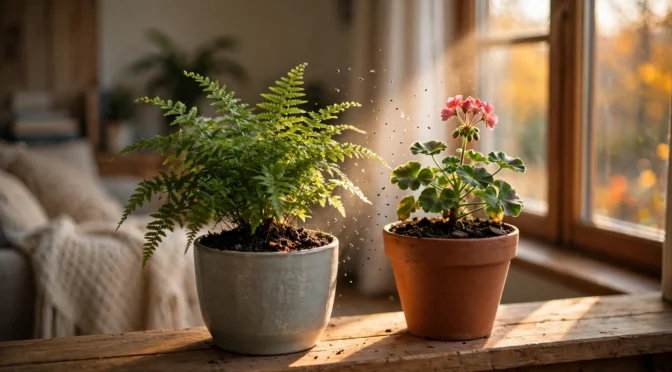
Gnat pest control starts with finding where they breed, not spraying the flies you can see. For fungus gnats around houseplants, let the top inch or two of potting mix dry between waterings. If the flies gather at a sink instead, clean the drain before you touch the plants.
If you have tried everything and the flies keep returning, check the source again. A yellow sticky card set flat on the potting soil and another by the sink can help show within a few days where to focus.
Why Do Gnats Show Up After Houseplants Move Indoors?
Plants can bring fungus gnat larvae indoors in damp potting mix. The adults are weak fliers that hover and run close to the soil, so you may notice them more around indoor pots and nearby lamps than you did outside.
When you bring plants inside for colder weather in Greater Cincinnati or Northern Kentucky, check their drainage before continuing your usual watering routine. Saucers holding standing water, pots without drainage holes and dense mixes that stay wet for days give the larvae the moisture they need.
Most indoor fungus gnat problems start as a watering problem before they are a pest problem. Empty the saucers and check the bottom of each pot before you blame the plant.
How Do You Tell Fungus Gnats From Fruit Flies and Drain Flies?
Don’t treat every tiny fly as a fungus gnat. A soil treatment won’t remove drain buildup, and cleaning a sink won’t stop larvae living in a wet flowerpot.
| Insect | What it looks like | Where you find it | Likely source |
|---|---|---|---|
| Fungus gnat | Slender, dark gray to black, long legs, wings held back over the body | Hovering and running near potted plants and nearby lamps | Damp potting soil |
| Fruit fly | Tan, with red eyes | Over ripe produce, open bottles, wet dish sponges | Food and fermenting liquids |
| Drain fly | Fuzzy, looks like a tiny moth | Resting on walls near sinks and tubs | Film inside drains |
| Phorid fly | Humpbacked, runs in jerky, erratic paths | Around sinks, drains and decaying organic matter | Drains or rotting material |
A small insect that jumps and bites people or pets may be a flea, not a fungus gnat. Our guide to professional flea treatment explains that separate problem.
How Do You Find Where the Swarm Starts?
Use sticky cards to compare activity near the pots and the drain before applying a product. Where the flies gather matters, but their appearance matters too.
- Set one yellow sticky card flat on the potting soil of an affected plant and another near the sink or tub drain. Keep them out of reach of children and pets.
- Check the cards over the next few days. Note which catches more flies and compare the insects with the descriptions above.
- If fungus gnats collect near the soil and hover around the pot, start with moisture and drainage.
- If drain or phorid flies gather near the sink, clean the drain and check for decaying material.
- While monitoring, look for standing water in saucers, pots that cannot drain and damp shelves or windowsills.
A card catching flies beside a sink is a clue, not proof that the drain is their breeding site. Confirm what the insect looks like before deciding what to treat.
How Do You Treat the Soil Without Harming the Plants?
Start with watering and drainage. A product cannot correct a pot that stays waterlogged.
Let the top inch or two dry out
Letting the top inch or two of potting mix dry between waterings is the most effective first step for fungus gnats. Their larvae depend on moist soil, so breaking that constant moisture interrupts breeding.
Check below the surface rather than watering because the calendar says it is time. Empty standing water from saucers, and make sure each pot drains. Keep the plant’s watering needs in mind rather than drying the entire root ball.
Use BTI exactly as the label says
BTI is a biological larvicide available in products labeled for fungus gnat larvae in soil. Choose one whose label lists both the pest and the intended plant use, then follow its application and repeat-treatment directions.
BTI targets larvae, not adults already flying around the room. Seeing adults after an application does not, by itself, tell you whether the larval treatment worked.
Treat hydrogen peroxide as a supplement
Hydrogen peroxide drenches can reduce larvae near the surface, but they do not reliably reach the whole root zone. Overuse can stress roots. They are not a substitute for correcting wet soil and poor drainage.
Repot only when the infestation is heavy
For a heavy infestation, rinsing the roots and repotting into fresh, sterile mix can help break the cycle. Bag the old soil and take it outside, away from the house. Correct the watering and drainage problem too, or the fresh mix can become another breeding site.
Why Don’t Aerosol Sprays Clear Indoor Gnats?
Aerosols kill exposed adults but leave larvae in the soil untouched. New adults can emerge while the breeding site remains wet.
Spray settles on counters and in pet bedding. That makes broad indoor spraying a poor first choice, especially in kitchens. Bug bombs are the wrong tool for larvae in potting soil or drain buildup; put the effort into removing the source instead.
When Do Indoor Flies Point to a Drain or Moisture Problem?
If flies cluster at a sink or tub, scrub the organic film out of the drain and fix any slow draining. Hot water alone is not a substitute for removing buildup. Drain and phorid flies can breed in decaying material that soil treatments never reach.
Look beyond the drain opening if flies persist. A leaking pipe under the sink, a damp basement or standing water in a crawlspace may point to a moisture source that needs plumbing or building repairs. Don’t enter an unsafe crawlspace to investigate.
When Should You Call a Pro for Indoor Flies?
You do not need to wait several weeks if the source is hidden or you cannot identify the flies. A professional inspection is appropriate when:
- Flies persist after several weeks of consistent soil drying and drain cleaning.
- They appear to come from inside a wall or a crawlspace.
- You cannot locate the source after checking the pots and drains.
Before treatment, ask which product will be used, where it will go and how long people and pets need to stay away. Those instructions should be specific to the treatment, not a blanket assurance that every application is harmless.
Sure Thing Pest Control is locally owned and family-run, serving Greater Cincinnati and Northern Kentucky since 1997. For help identifying the source, call 513.247.0030 for a free estimate, review our Cincinnati fly control services, or request a pest control quote online.
Frequently asked questions
What insects kill gnats?
Some predatory insects and mites feed on fungus gnat larvae, but introducing them is not the first step for a household problem. Start by correcting wet potting soil and drainage. If larvae persist, consider a product labeled for fungus gnats on your plants.
How much does it cost to get rid of a gnat infestation?
The cost depends on the source and the work needed to correct it. Drying potting soil costs nothing, while sticky cards, labeled treatments or professional service add costs. Sure Thing Pest Control offers free estimates at 513.247.0030.
What is the difference between a flea and a gnat?
Fleas jump and bite people or animals; fungus gnats fly or run near damp potting soil and do not bite people. The source and treatment are different. Our flea exterminator article explains the approach for fleas.
Do I have to throw out the plant?
Usually, no. Start by improving drainage, emptying saucers and letting the top inch or two of mix dry as the plant tolerates it. A heavy infestation may justify repotting into fresh, sterile mix rather than discarding the plant.
What are these tiny black flies in my house?
Slender, dark flies hovering around pots are likely fungus gnats. Fuzzy, mothlike flies near sinks suggest drain flies, while humpbacked flies that run in jerky paths may be phorid flies. Check both their appearance and where they gather before choosing a treatment.


 Some mosquito species will hibernate during the winter months and re-emerge when the warmer weather begins, while other species will hatch in spring from eggs previously laid in the fall. Generally, mosquito activity will begin once we have a couple of days when the temperature reaches 50° F. As the temperatures continue to rise, the mosquito population will also increase. This is why in the peak of the hot summer months we see the most mosquito activity.