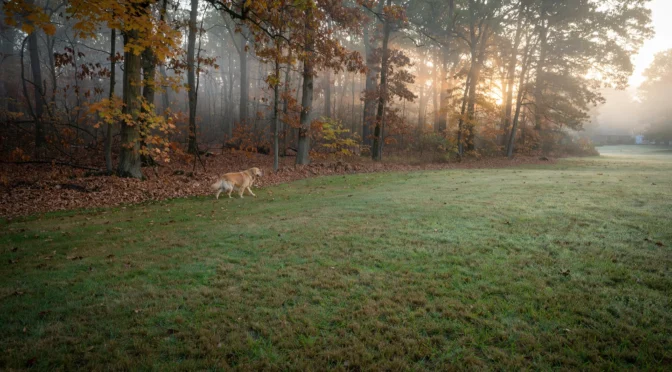
Ohio’s blacklegged ticks can stay active through fall and on mild winter days, so a light frost does not end tick season. For a wooded yard in Greater Cincinnati or Northern Kentucky, start by clearing damp leaf piles along the woods and checking your dog after walks. Yard treatment adds protection but does not replace those steps.
If you have tried everything and still find ticks on your dog, look closely at where the dog walks. Leaves piled against a fence or tree line hold moisture and put tick habitat beside a familiar sniffing route.
Are Ticks Still Active in Ohio in October and November?
Yes. The Ohio Department of Natural Resources identifies fall as an active season for adult blacklegged ticks, also called deer ticks. Adults also seek hosts on mild winter days. Human Lyme disease cases peak in summer, but that does not mean ticks disappear when the heat breaks.
Ohio State University Extension notes that one or more blacklegged tick life stages may be active in every month, depending on temperature. Use the conditions in your yard, not the calendar, to decide when to check for ticks. Damp leaves beside a wooded lot deserve attention even after a frost.
Which Fall Ticks Matter Most for Dogs and Children?
Blacklegged ticks deserve particular attention in fall because they transmit the bacterium that causes Lyme disease. Greene County Public Health identifies them as the only Lyme disease vector in the Midwestern United States. American dog ticks have a different seasonal pattern: Ohio State University Extension puts their greatest adult abundance between mid-April and mid-July.
| Feature | Adult blacklegged (deer) tick | American dog tick |
|---|---|---|
| Size | Much smaller | Larger |
| Color | Adult females have a dark shield and reddish-brown body | Tan and white markings |
| Seasonal activity | Adults active in fall and on mild winter days | Adults most abundant mid-April to mid-July |
| Lyme disease | Transmits the Lyme disease bacterium | Does not transmit Lyme disease |
Part your dog’s fur rather than checking only by feel. Small ticks are easy to miss around the ears and between the toes. Season can help narrow the possibilities, but it cannot identify a tick by itself.
Why Does Wet Leaf Litter Keep Questing Ticks Alive?
Ticks lose moisture easily. Shaded, matted leaves protect them from drying out, especially where the lawn meets the woods. Ohio State University Extension identifies forested areas and their edges as typical blacklegged tick habitat.
Ticks wait on low vegetation for a host to brush past, a behavior called questing. They do not need to cross the open lawn if your dog walks directly through the damp edge. Deer movement through wooded lots can also bring tick hosts close to the yard.
What Yard Habits Cut Tick Habitat Along the Woods Edge?
The first habit to change is piling October leaves against the woods where your dog walks. Move that material away from the route rather than treating the pile and leaving the shelter in place.
- Rake or blow accumulated leaves away from the tree line and fence.
- Bag leaves or spread them thinly over open lawn where they can dry.
- Keep the lawn mowed and separate it from woodland leaf litter.
- Move your dog’s walking route away from the wooded edge when practical.
- Check your dog after every walk through leaves or brush.
Leaf piles and the tree line
A tidy pile in a shady back corner can still hold moisture. Pay particular attention to leaves trapped beneath shrubs or along a fence, where they mat down instead of blowing free. Clear them as they accumulate rather than waiting for the last leaves to fall.
The strip between lawn and woods
A clear, dry strip of gravel or mulch helps separate the mowed yard from wooded habitat. Choose its width after checking the slope and drainage along the actual edge. The strip should stay clear of leaf buildup; covering it with damp leaves defeats its purpose.
Can You Spray Your Yard for Ticks Before the Ground Freezes?
Yes, when conditions and the product label allow it. Professional perimeter treatments target vegetation and leaf litter where ticks wait, rather than treating the open lawn as the main problem. Rain can affect an application, and wind can limit where an applicator can work safely.
A yard spray cannot prevent every tick encounter. Sure Thing Pest Control offers kid and pet friendly tick treatments, with free estimates available by phone or through the website form. Ask which areas will be treated and exactly when children and pets can return. The Cincinnati tick control and extermination page explains the service, and the FAQs address common treatment questions.
How Do You Check Your Dog and Remove a Tick Safely?
Check your dog after each walk through leaf litter, and remove an attached tick as soon as you find it. A feeding tick may look swollen and gray, so do not rely on the color of an unfed tick to recognize it. Appearance alone cannot tell you exactly how long it has been attached.
- Use fine-tipped tweezers to grasp the tick as close to the skin as possible.
- Pull straight up with steady pressure. Do not twist or jerk.
- Avoid squeezing the body. Do not use heat or petroleum jelly.
- Clean the bite area and your hands.
- Keep the tick in a sealed bag in case your veterinarian needs to identify it.
Ask your veterinarian which tick prevention is appropriate for your dog and where you walk. Yard treatment does not replace veterinary prevention. Record the date you found the tick, and call your vet if you cannot remove it or your dog becomes unwell.
What Should You Ask a Tick Control Company Before You Book?
Ask the applicator to identify the habitat being treated. On a wooded lot, the answer should address the vegetation and leaf litter along the edge, not just the square footage of grass.
- Where will you apply treatment, including along the tree line?
- What return visits are recommended, and what is included in the price?
- When can my dog and children use the treated area again?
- What weather conditions would require rescheduling?
- Are the technicians licensed, and what training do they receive?
Sure Thing Pest Control has been locally owned and family-run since 1997. Our two owners bring over 80 years of combined pest control experience. Our licensed and certified technicians are background checked and complete more than 40 hours of additional training annually; details appear on our credentials page.
For a wooded yard in Greater Cincinnati or Northern Kentucky, request a free estimate and point out where you are finding ticks or where your dog walks. Call 513.247.0030 or use the contact page.
Frequently asked questions
Are ticks still active in Ohio in November?
Yes. Adult blacklegged ticks remain active in fall and can seek hosts on mild winter days, according to the Ohio Department of Natural Resources. A light frost is not a reason to stop checking your dog after walks through leaves or brush.
Can you spray for ticks outside in late fall?
Yes, if the weather and product label permit treatment. An applicator should assess the vegetation and leaf litter where ticks wait, then explain when people and pets can return. Treatment works alongside leaf removal and pet checks, not instead of them.
Which month are ticks most active in Ohio?
There is no single peak month for every tick species and life stage. American dog tick adults are most abundant from mid-April to mid-July, according to Ohio State University Extension. Blacklegged tick nymphs are active in spring and summer, while adults also remain active through fall and mild winter weather.
Is 2026 the worst tick season?
The available figures do not establish that. WTOL 11 reported on April 21, 2026, that CDC data showed April tick-related emergency visits at 84 per 100,000 people, more than double the usual rate. That indicates elevated spring activity, not a ranking of Ohio’s entire tick season.
What smell do ticks hate most on people?
Do not rely on a scent alone to prevent tick bites. Choose an EPA-registered repellent labeled for ticks and follow its application directions. Check your body after time in wooded or brushy areas, even when you use repellent.